


The Music Genius Worth $156 Million Who Never Wrote a Will
- Bruce Alford

- Jun 24
- 3 min read
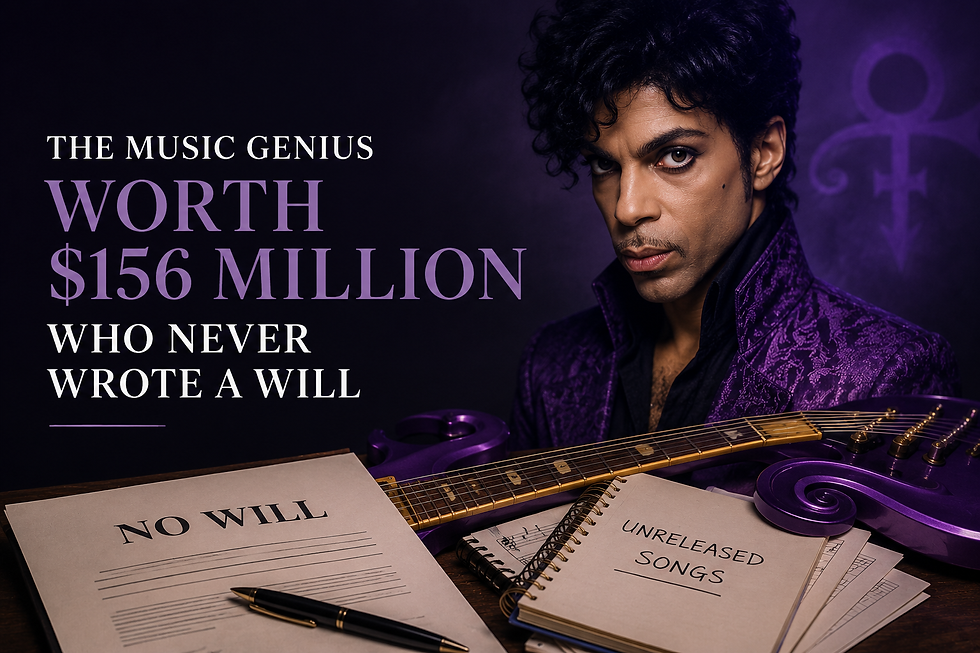
Prince controlled almost everything about his career — his masters, his image, even the spelling of his own name. But when he died suddenly in April 2016 at age 57, investigators searching his Paisley Park estate found something surprising for a man so protective of his legacy: no will. No trust. No estate plan of any kind.
With an estate eventually valued around $156 million — including a legendary music catalog and a vault of unreleased recordings — that single omission set off one of the most expensive probate sagas in recent memory.
Because Prince left no instructions, a Minnesota court had to step in and apply the state’s intestacy rules — the default formula for people who die without a will. First it had to figure out who the heirs even were. More than 45 people came forward claiming a piece of the estate. After sorting through the claims, the court recognized six of his siblings and half-siblings as the legal heirs, since Prince had no surviving spouse or children.
Then the real fight began. The heirs couldn’t agree on how to value or manage the assets, professional administrators clashed with the family, and the IRS disputed the estate’s valuation in a battle over tens of millions in taxes. Lawyers and consultants were paid enormous sums. It took until 2022 — six years — for a judge to finally approve a settlement, by which point two of the heirs had died waiting. The estate ended up split roughly in half between the surviving heirs and a music company that had purchased other heirs’ interests, and even then, more litigation followed.
None of it had to happen. A basic estate plan could have named who got what, kept the details private, and spared his family years of public conflict.
What’s a will?
A will is a legal document that states who gets your assets when you die, who should care for your minor children, and who you trust to carry out those instructions (the “executor”). When you die without one — intestate, as Prince did — the law decides for you using a rigid default formula that often doesn’t reflect what you actually wanted.
Wills also go through probate, a court-supervised process that is part of the public record.
That’s why so many private details of Prince’s estate ended up in the headlines.
What’s a trust?
A trust is a legal arrangement where you (the “grantor”) place assets under the management of a trustee for the benefit of someone (a “beneficiary”), under rules you set. A revocable living trust can keep assets out of probate entirely — passing directly and privately to your beneficiaries, without a public court fight of the kind that consumed Prince’s estate for six years.
Why bother with either?
A few of the most common benefits:
Control. You choose your heirs and what each receives — rather than letting a default statute decide.
Avoiding probate. Trusts can spare your family the slow, costly, public process Prince’s heirs endured.
Privacy. A trust generally keeps your affairs out of the public record.
Reducing fights. Clear documents make it far harder for relatives — or strangers claiming to be relatives — to contest your wishes.
Saving money and time. Planning ahead is almost always cheaper than the litigation that follows when there’s no plan.
Protecting your legacy. For creative work or a business, a plan keeps control where you want it instead of in a courtroom.
The takeaway
Prince guarded his life’s work fiercely — and then left its fate to a default statute and a six-year court battle. The irony is hard to miss. The fix would have been comparatively simple: put his wishes in writing and structure them while he was alive.
You don’t need a $156 million catalog for this to matter. Whatever your wishes are, the worst version is the one no one ever wrote down.
Request your free consultation: https://www.brucealfordlaw.com/dallas-business-law-firm-near-me
This post is for general educational purposes and isn’t legal or financial advice. Estate laws vary by state and country, so talk to a qualified attorney about your specific situation.


Comments